Criminal justice system in Punjab needs forensic evidence governance reforms
Weak investigations and broken evidence chains continue to undermine convictions

Shakir Ahmad Shahid
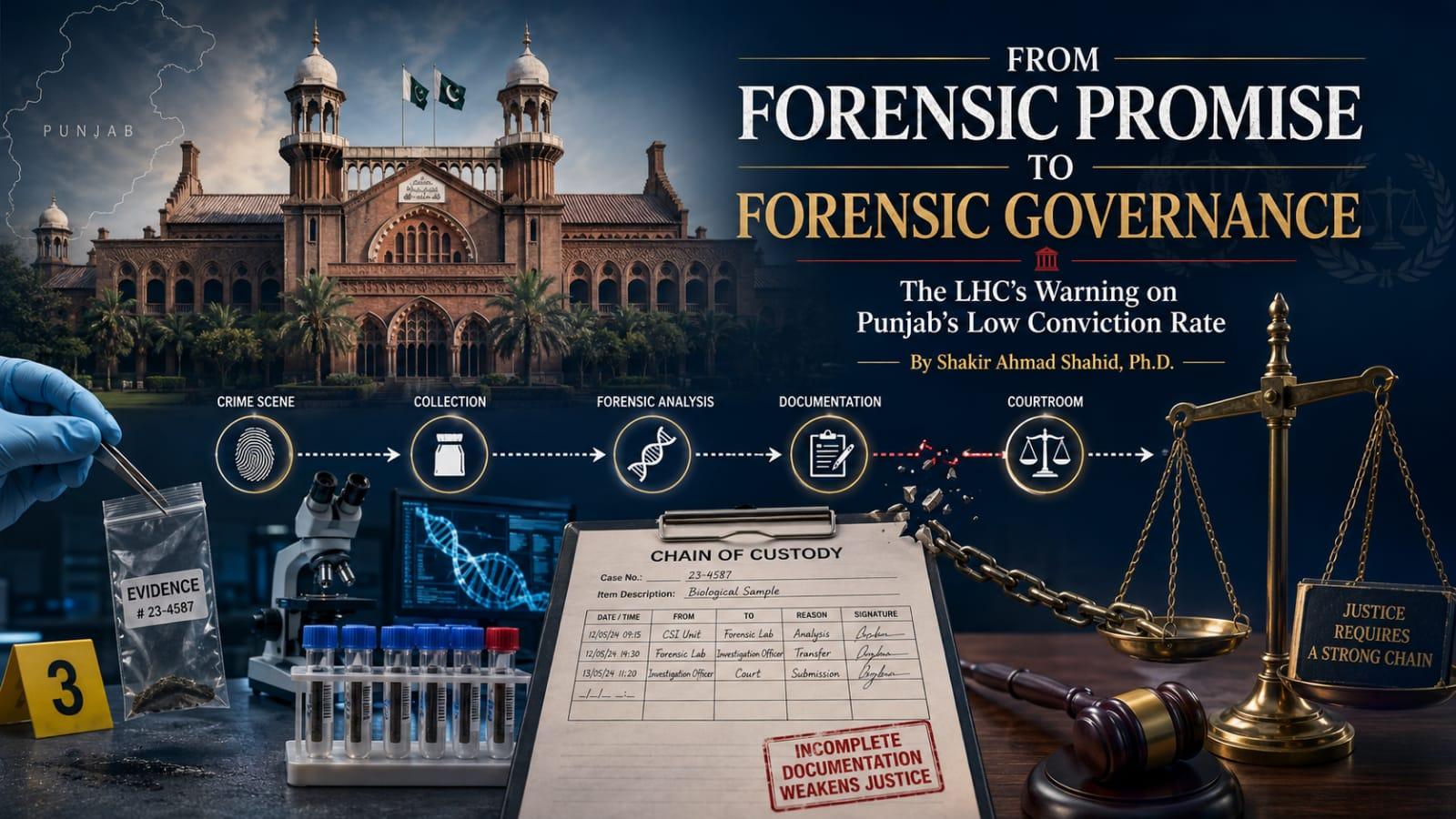
The recent Lahore High Court (LHC) judgment setting aside a conviction in a rape case should be read not merely as an appellate correction in one criminal case, but as a policy-level warning about the criminal justice system of Punjab. The Court identified poor investigation, weak prosecution, and mishandling of forensic evidence as major causes behind Punjab’s low conviction rate.
In doing so, it exposed a deeper institutional problem: Punjab has invested in forensic capacity, but the legal system still lacks a fully governed forensic evidence ecosystem capable of converting scientific potential into reliable courtroom proof. (Dawn)
The judgment is significant because it shows that forensic evidence does not become reliable merely because it comes from a laboratory. A DNA report, fingerprint report, toxicology report, digital forensic report, or medico-legal opinion becomes legally meaningful only when the entire evidentiary chain is properly governed, documented, verified, presented, and tested before the court.
I. The Case and the Evidentiary Failure Identified by the Court
The case, as reported, involved the reversal of a 10-year sentence awarded under Section 376 of the Pakistan Penal Code. The Lahore High Court found that the prosecution case suffered from serious evidential defects. The Court noted that the investigating officer failed to collect material evidence relating to the birth of the child allegedly conceived as a result of the offence, including hospital or midwife records, birth certificate, and identification details of the child. (Dawn)
More importantly for forensic governance, the Court found that the handling and custody of DNA samples had not been properly documented, the identities of persons presented for DNA testing had not been verified, and the chain of custody had not been maintained. These failures compromised the reliability of the forensic evidence and weakened the prosecution case. (Dawn)
The judgment therefore does more than correct an error in one trial. It spells out, in practical terms, the critical ingredients required for forensic evidence to become admissible, reliable, and persuasive.
II. What the Court Spelled Out: The Ingredients of Forensic Admissibility
Synthesizing the judgment, the Lahore High Court effectively articulated a multi-element threshold for forensic evidence to be safely placed before a court. These elements include:
- Chain of custody integrity — an unbroken and documented evidentiary pathway from crime scene to laboratory to courtroom;
- Identity verification — confirmed identification of all persons from whom biological or other samples are collected;
- Corroborative documentation — independent documentary evidence anchoring the forensic claim to factual reality;
- Foundational witness evidence — live testimony establishing how the evidence was collected, sealed, handled, transferred, received, analyzed, and presented;
- Prosecutorial gateway scrutiny — active pre-trial review of the evidentiary package before the matter reaches the court; and
- Institutional coordination — operational collaboration between the investigating agency, prosecution, forensic laboratory, medico-legal system, and court.
The Court’s reasoning confirms a basic but often neglected truth: forensic evidence is not self-authenticating. It must be legally constructed through proof of collection, identity, custody, handling, examination, interpretation, reporting, and courtroom presentation.
III. The Prosecutor as Gatekeeper, Not Passive Receiver
The Court’s criticism of the prosecution is equally important. It observed that prosecutors failed to perform their statutory “gate-keeping function” by not returning the police file for removal of obvious evidential defects.
Section 9 of the Punjab Criminal Prosecution Service Act, 2006 requires scrutiny of police reports and permits defective reports to be returned for removal of defects. Independent summaries of Punjab prosecution law describe this scrutiny function as including return of defective reports, submission of fit reports, and written scrutiny opinions where required. (RSIL)
This is a crucial point for reform. Prosecutors should not function as passive receivers of police files. They must act as pre-trial quality-control officers. In every case involving DNA, fingerprints, digital evidence, toxicology, firearms, trace evidence, medico-legal evidence, or other scientific material, the prosecutor should verify whether the foundational evidentiary requirements have been fulfilled before the challan proceeds to trial.
IV. The Real Message: Forensic Failure Is Governance Failure
The real message of the judgment is that forensic failure is rarely a laboratory-only problem. It is usually a governance failure spread across the entire evidentiary chain: first responder, investigating officer, medico-legal officer, forensic laboratory, prosecutor, trial court, and appellate review.
Where one link fails, the whole evidentiary chain becomes vulnerable. A laboratory may produce a scientifically valid result, but that result may still fail in court if the sample identity is doubtful, the chain of custody is broken, the collection process is undocumented, the foundational witnesses are missing, or the prosecutor has failed to cure defects before trial.
Punjab’s low conviction rate, therefore, cannot be addressed simply by demanding more convictions. It must be addressed by producing better cases. Better cases require better evidence. Better evidence requires integrity and scientific validity. And both require governance.
V. The Chief Minister’s Reform Mandate and the Governance Gap
Punjab is not without reform momentum. Chief Minister Maryam Nawaz’s government has repeatedly emphasized modern policing, technology, and forensic evidence. The province has moved to give legal backing to Crime Scene Units, with reported rules regulating evidence collection, presentation in court, video recording, and CSU testimony. (Dunya News)
In parallel, the Chief Minister has approved technology-driven measures such as a Punjab Cyber Crime Investigation Unit, modern drone systems, and transformation of the Crime Control Department into a premier investigation agency using modern forensic techniques, AI-based software, and advanced investigative tools. (Radio Pakistan)
The government has also announced major investment in forensic modernization, including modernization of PFSA, establishment of forensic laboratories across different regions of the province, and enhanced institutional oversight of forensic science governance. The proposed Punjab Forensic Science Authority Act, 2024 also points toward a more autonomous and technically specialized forensic authority.
These initiatives are important. But the LHC judgment shows that equipment and technology are not enough.
A cone, cordon tape, DNA kit, forensic van, camera, drone, AI tool, cyber unit, or laboratory report cannot rescue a case if the foundational legal architecture is missing. Laboratories cannot rehabilitate a chain of custody broken at the crime scene. Autonomous authority structures cannot compensate for prosecutors who lack the competence or discipline to scrutinize forensic evidence. Modern equipment cannot create institutional memory, professional culture, and interagency coordination by itself.
It is necessary that Chief Minister’s reform agenda be implemented by the next generation of reform: forensic evidence governance.
VI. From Forensic Capacity to Forensic Governance
Punjab now needs to move from forensic promise to forensic governance. This means connecting investigation, prosecution, laboratory science, medico-legal practice, judicial evaluation, and appellate review into one accountable evidentiary lifecycle.
Forensic governance is not merely the existence of a forensic laboratory. It is the institutional system through which forensic evidence is collected, preserved, analyzed, interpreted, disclosed, challenged, admitted, and relied upon in court.
It requires standards, training, documentation, audit, accountability, judicial scrutiny, defence disclosure, quality assurance, and continuous learning from failed cases. Without these components, forensic science remains an isolated technical capacity rather than a functioning pillar of justice.
VII. Policy Framework for Reform
1. Establish Binding Chain-of-Custody Standards for Field Evidence Collection
The most urgent reform is the creation and enforcement of binding standard operating procedures for forensic evidence collection in the field. These standards should apply to all Punjab Police officers and should be enforceable through command accountability.
They should cover scene security, sample collection protocols, packaging, sealing, labeling, storage, transportation, documentation, contemporaneous recording, and identity verification at each transfer point.
These standards should be developed with PFSA’s technical input, reviewed against ISO/IEC 17025:2017 and relevant OSAC guidelines, and incorporated into police rules as well as prosecution scrutiny checklists. Compliance should be subject to periodic audit and command-level accountability.
2. Train Investigating Officers in Case-Specific Forensic Strategy
Police training must move beyond general investigation courses. Every investigating officer should be trained in forensic evidence collection, contamination prevention, packaging, sealing, documentation, digital chain of custody, sample identity verification, and case-specific forensic strategy.
In rape and sexual violence cases, training must include medico-legal coordination, pregnancy-related evidence, biological sampling, victim-sensitive procedures, timely preservation of corroborative material, and proper linkage between medical, biological, documentary, and testimonial evidence.
The LHC judgment shows that the problem was not merely failure to obtain a laboratory report. It was failure to build the factual and evidentiary foundation around that report.
3. Make Prosecution a Real Pre-Trial Quality-Control Institution
Section 9 of the Punjab Criminal Prosecution Service Act, 2006 is not self-executing. Its gatekeeping function requires forensic literacy, institutional discipline, and standardized review mechanisms.
The Punjab Criminal Prosecution Service should develop mandatory forensic evidence checklists for all serious cases involving scientific evidence. No challan involving DNA, fingerprints, digital evidence, toxicology, firearms, trace evidence, or medico-legal evidence should proceed to trial unless the prosecutor certifies that the foundational documents are complete.
These should include chain-of-custody forms, sample identity records, seizure memos, medico-legal documents, laboratory reports, analyst details, witness lists, and court presentation requirements.
The Prosecutor General should also institutionalize forensic literacy training in collaboration with PFSA and academic forensic scientists. Prosecutors must know not only what forensic disciplines are, but what must be verified in a police file before evidence can survive judicial scrutiny.
4. Issue High Court Criminal Practice Directions on Forensic Evidence
Trial courts also need forensic capacity. A judge cannot meaningfully evaluate forensic evidence without structured legal and scientific assistance.
The Lahore High Court should consider issuing comprehensive criminal practice directions on forensic evidence. These directions should cover collection, preservation, transmission, laboratory reporting, expert testimony, admissibility evaluation, disclosure to the defence, and judicial reasoning on scientific evidence.
Such directions should clarify that forensic admissibility is not a ritualistic exhibition of a report. It is a structured judicial assessment of integrity, scientific validity, relevance, and probative value.
The directions should also define the minimum documentation required to establish chain of custody, the obligations of trial courts when forensic evidence is tendered without adequate foundation, the treatment of expert evidence, and the circumstances in which independent expert assistance may be required.
5. Reform PFSA Reporting Templates and Defence Disclosure
PFSA should revamp its reporting and discovery templates. Forensic reports should not merely state conclusions. They should disclose the method used, sample condition, limitations, controls, contamination safeguards, statistical interpretation, uncertainty, analyst identity, accreditation status, and whether the result is a source-level, activity-level, or evaluative conclusion.
Standardized report templates should be developed for each forensic discipline. These may be modeled on internationally recognized standards, including those developed by SWGDAM for DNA, SWGTREAD for footwear and tire-track evidence, and relevant OSAC standards for other forensic domains.
Defence disclosure packages should include relevant bench notes, chain-of-custody records, electropherograms or digital data where applicable, validation material, quality incidents, proficiency testing records, instrument logs, and interpretive assumptions.
This reform directly responds to the LHC’s concern that foundational facts necessary for forensic admissibility were not properly placed before the court.
VIII. The Required Institutional Shift
The LHC judgment should become a turning point. Punjab already has many institutional ingredients: PFSA, crime scene units, prosecution service, police reform initiatives, judicial oversight, and political interest in modernizing criminal justice.
What is missing is integration.
The province needs a unified forensic evidence governance framework that connects investigation, prosecution, laboratory science, medico-legal practice, and adjudication into one accountable lifecycle.
That framework should ensure that forensic evidence is not treated as a disconnected laboratory product, but as a legally governed evidentiary process. Every stage — from scene protection to final appellate review — must be documented, verified, auditable, and defensible.
IX. Conclusion: Better Convictions Require Better Governance
Low conviction rates are not corrected by demanding more convictions. They are corrected by producing better cases.
Better cases require better evidence. Better evidence requires integrity and scientific validity. Integrity and scientific validity require governance.
The Lahore High Court has warned Punjab that forensic promise alone is not enough. The next stage of reform must move beyond laboratories, equipment, and technology toward a fully governed forensic evidence ecosystem.
Punjab has the opportunity to become a model jurisdiction in forensic-led justice. But that will happen only if forensic reform is understood not as a technology project, but as an institutional governance project.

-- Shakir Ahmad Shahid, PSP, PhD, is a policy-level forensic scientist, a Fulbright alumnus in forensic science, and author of multiple books on Forensic Evidence Governance and Forensic-Centric Miscarriage of Justice. He can be reached at drsashahid@gmail.com
Disclaimer: The views expressed in this article are those of the author and do not necessarily reflect the official policy or position of www.gnnhd.tv

Turkey lays out plans for defence pact with Pakistan and Saudi Arabia
- 2 hours ago

Apple could help you prove your iPhone photos aren’t deepfakes
- 5 hours ago

How Ukraine is holding its own against Russia — and changing warfare as we know it
- 12 hours ago

Joby flexes military muscle with $500 million defense acquisition
- 5 hours ago

Keychron’s wireless Hall effect keyboard is back to its lowest price
- 14 hours ago

Pakistanis to celebrate Independence Day tomorrow with national zeal
- an hour ago

Costco’s great Switch 2 console bundle includes over $100 in free stuff
- 14 hours ago

Norwegian FM, CDF Munir discuss regional security, defence cooperation
- 2 hours ago

Iran says Strait of Hormuz is under its control, Fars news reports
- 2 hours ago

Trump’s catering truck caper
- 12 hours ago

Zubair Rehman: bridging music, creativity and digital entrepreneurship
- 9 minutes ago

Everybody needs a personal AI policy. Just ask Hank Green.
- 12 hours ago