Technology
- Home
- Technology
- News
Seven tech giants signed Trump’s pledge to keep electricity costs from spiking around data centers
Leaders from Google, Meta, Microsoft, Oracle, OpenAI, Amazon, and xAI met with President Donald Trump today to sign a "rate payer protection pledge." It's one way they're responding to growing bipartisan concerns about electricity rates rising as tech compani…

Published 7 months ago on Mar 8th 2026, 2:01 pm
By Web Desk
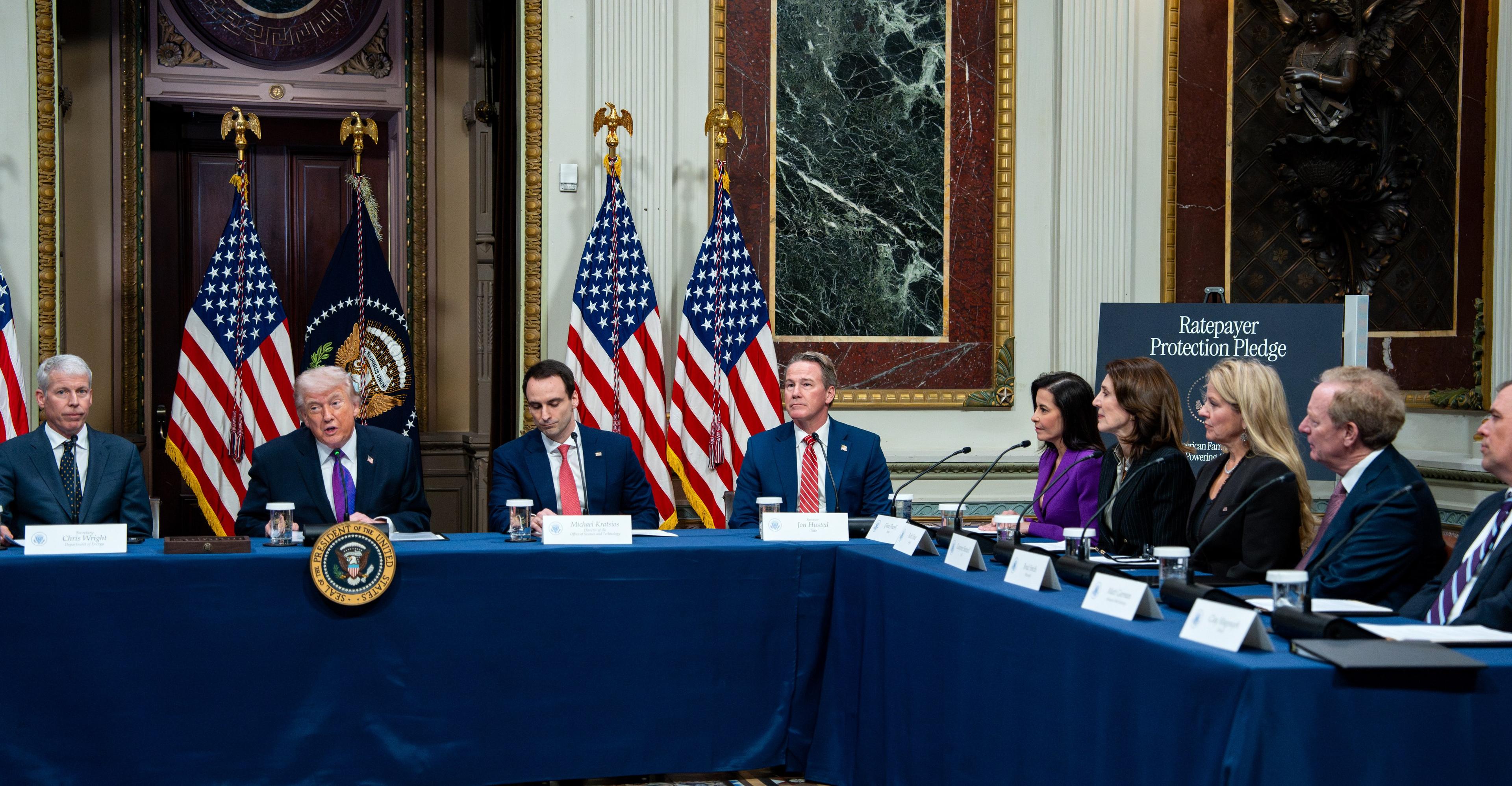
Leaders from Google, Meta, Microsoft, Oracle, OpenAI, Amazon, and xAI met with President Donald Trump today to sign a “rate payer protection pledge.” It’s one way they’re responding to growing bipartisan concerns about electricity rates rising as tech companies and the Trump administration rush to build out a new generation of AI data centers.
“[Tech companies] need some PR help because people think that if a data center goes in, their electricity prices are going to go up,” Trump said during the event. “Some centers were rejected by communities for that and now I think it’s going to be the opposite.”
Trump signed a proclamation formally introducing the ratepayer protection pledge today during a roundtable event, following up on claims he made during his State of the Union speech last week. The proclamation says that “these companies will build, bring, or buy the new generation resources and electricity needed to satisfy their energy demands, and pay for all new power delivery infrastructure upgrades to service their data centers.”
The move comes as tech companies scramble to quell growing opposition to data centers that require tremendous amounts of electricity to train and run generative AI models. Household electricity bills rose 13 percent nationally in 2025, according to a December report from advocacy group Climate Power. And data center electricity demand could double or triple by 2028, the Department of Energy estimates.
According to the proclamation, the seven companies present at the event have “accepted the terms of the Ratepayer Protection Pledge” and that “the commitments embodied therein effectuate the national policy of the United States.” It adds, however, that the companies would still need to “voluntarily negotiate” agreements with utilities and state governments.
The president said that the companies will be responsible for adding capacity to the grid “where possible.” He also said they would cover the costs of upgrading existing power infrastructure to meet growing electricity demand. Trump added that the companies should negotiate separate rate structures with utilities, an attempt at ensuring they pay a fair rate for all the extra pressure a data center puts on the grid. Companies would be on the hook for these costs even if data centers don’t wind up using all of the additional electricity generated. That’s a key measure that could address fears that local communities would be left holding the tab for new power plants and transmission lines that become stranded assets if hype around AI fizzles out and data center projects fall flat.
Trump said that the tech giants would “use their infrastructure to contribute back up power to local grids during times of need.” Reducing how much power a data center uses when electricity demand peaks — during a severe winter storm or heatwave, for example — is a measure that could help prevent power outages during disasters. This year’s winter storms have raised concerns about how new data centers could further stress power grids and hike up electricity prices during disasters. Texas passed a law last year giving the local grid operator the authority to cut data centers’ energy use during an emergency. The pledge itself is more vague, saying that companies would “whenever possible, make available their backup generation resources at times of scarcity.”
During the event, Gwynne Shotwell, President and COO of SpaceX (which recently announced it’s merging with xAI with the idea of pursuing plans to shoot data centers into space), said that xAI would develop a 1.2 gigawatt power plant as its supercomputer’s primary power source. The company would similarly develop as much power generation for “every additional data center,” Shotwell said. xAi also plans to expand its Megapack installation to provide backup power to Memphis, Tennessee and Southaven, Mississippi. The NAACP has already threatened to sue xAI twice over pollution from temporary gas turbines it has installed in Tennessee and Mississippi to power its data centers.
The pledge also includes a commitment to hire from local communities where data centers are under construction. Meta announced today that it launched a pilot program in Ohio to train fiber technicians, including some who attended today’s event.

Trump welcomes China's president Xi to Washington for lavish state summit
- 12 hours ago
IMF review calls for 'fewer but deeper' reforms in design of loan programs
- 8 hours ago

Trump gets a Greenland deal
- a day ago

Does AI need an antitrust exemption so it doesn’t kill everyone????
- a day ago
Magnitude 5.1 earthquake rattles eastern Turkiye, EMSC says
- 14 hours ago

Pakistan deploys 'thousands of security forces' ahead of planned PTI's Islamabad protest
- 10 hours ago

The uncomfortable truth about aquariums
- a day ago

It’s not your imagination — dating has gotten way more combative lately
- a day ago

UN says AI safeguards can’t wait for certainty
- 15 hours ago

The psychology behind Trump’s obsession with DC renovations
- a day ago

Dr Najeeb Naqi from PML-N elected 25th president of Azad Jammu and Kashmir
- 14 hours ago

Security researchers used Claude to help them hack into OpenAI
- a day ago
You May Like




Trending