China seeks de-escalation, EU considers naval mission changes

Published 6 months ago on Mar 16th 2026, 8:01 pm
By Web Desk
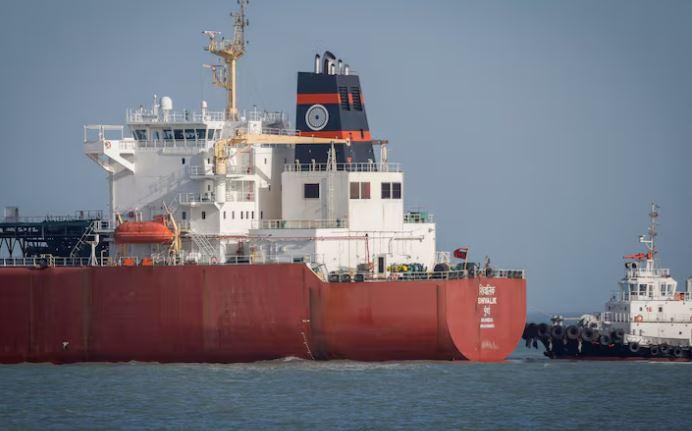
BERLIN/BRUSSELS/LONDON (Reuters): U.S. allies said they had no immediate plans to send ships to unblock the Strait of Hormuz, rebuffing a request by President Donald Trump for military support to keep the vital waterway open.
Trump called on nations to help police the strait after Iran responded to U.S.-Israeli attacks by using drones, missiles and mines to effectively close the strategic channel off its shores for tankers transporting a fifth of global oil supply.
Most NATO countries, several of whom have been at the sharp end of criticism from Trump in recent months, are usually wary of angering the White House but are now signalling reluctance to become embroiled in the conflict with Tehran.
"What does (...) Donald Trump expect a handful or two handfuls of European frigates to do in the Strait of Hormuz that the powerful U.S. navy cannot do?" German Defence Minister Boris Pistorius said in Berlin on Monday, as he downplayed threats by Trump that failing to come to Washington's aid could have consequences for the NATO alliance.
"This is not our war, we have not started it," he added.
The conflict has nothing to do with NATO and Germany has no plans to be drawn into it, government spokesperson Stefan Kornelius said.
"Neither the United States nor Israel consulted us before the war, and ... Washington explicitly stated at the outset of the war that European assistance was neither necessary nor desired," the spokesperson said.
Still, some allies signaled a cautious willingness to help.
EU foreign policy chief Kaja Kallas said the bloc is in talks with the United Nations about replicating a deal that allows for grain to be exported out of Ukraine during its war with Russia.
CHINA TALKING WITH ALL SIDES
The EU is also discussing whether it could change the mandate of its Middle East naval mission, Aspides, which currently protects ships in the Red Sea from attacks by Yemen's Houthi rebel group, to include the Strait of Hormuz, Kallas said.
But Greece, which leads the Aspides mission, will limit its participation in the Middle East to the Red Sea, said government spokesman Pavlos Marinakis.
China is talking with all sides about the strait as it seeks to de-escalate the conflict, its foreign ministry said on Monday.
Britain will work with allies on a collective plan to secure freedom of navigation through the strait, Prime Minister Keir Starmer said, while acknowledging that it wouldn't be easy and reiterating the U.K. would not be drawn into a wider war.
The U.K. has autonomous mine-hunting systems that could be used, Starmer said. Denmark said the EU should work to re-open the strait even if it didn't agree with the war.
"Even if we don't like what's going on, I think it's wise to keep an open mind on whether Europe ... in some way can contribute, but with a view towards de-escalation," Danish Foreign Minister Lars Lokke Rasmussen said.
But other European nations appeared to rule that out. Spain said it would not do anything that could escalate the conflict, while Italian Deputy Prime Minister Matteo Salvini said sending military ships to a war zone would be interpreted as participation in the conflict.
"Italy is not at war with anyone and sending military ships in a war zone would mean entering the war," Salvini told reporters in Milan.

An Israeli documentary about Gaza is sweeping the world – and Israelis are furious
- a day ago

Your robotaxi might be a narc
- a day ago

Snap is launching a new Specs AI tool, and it’s coming to iOS and Mac
- a day ago

All seven Khwarij involved in Kohat mosque blast neutralized
- 2 days ago

Apple Home’s new security camera features cost up to $60 a month
- 2 days ago

Planning Minister Iqbal inaugurates upcoming anti-polio drive
- 2 days ago
Trump extends push for $100,000 H-1B visa fee by another year
- 2 days ago

Voters mostly don’t like AI and data centers, but neither party seems to have an edge
- 2 days ago

Microsoft announces Windows and Surface event for October 7th
- 2 days ago
Afghan soil must not be used for terrorism: DG ISPR
- 2 days ago

Bose’s next open earbuds have more bass, more volume, and more battery life
- a day ago

Xbox’s clever disc-to-digital feature was 15 years in the making
- 9 hours ago
You May Like



Trending