- Home
- Technology
- News
'Water worlds' more common than previously thought, research suggests
Planets with water are more common than previously thought, surprise finding suggests

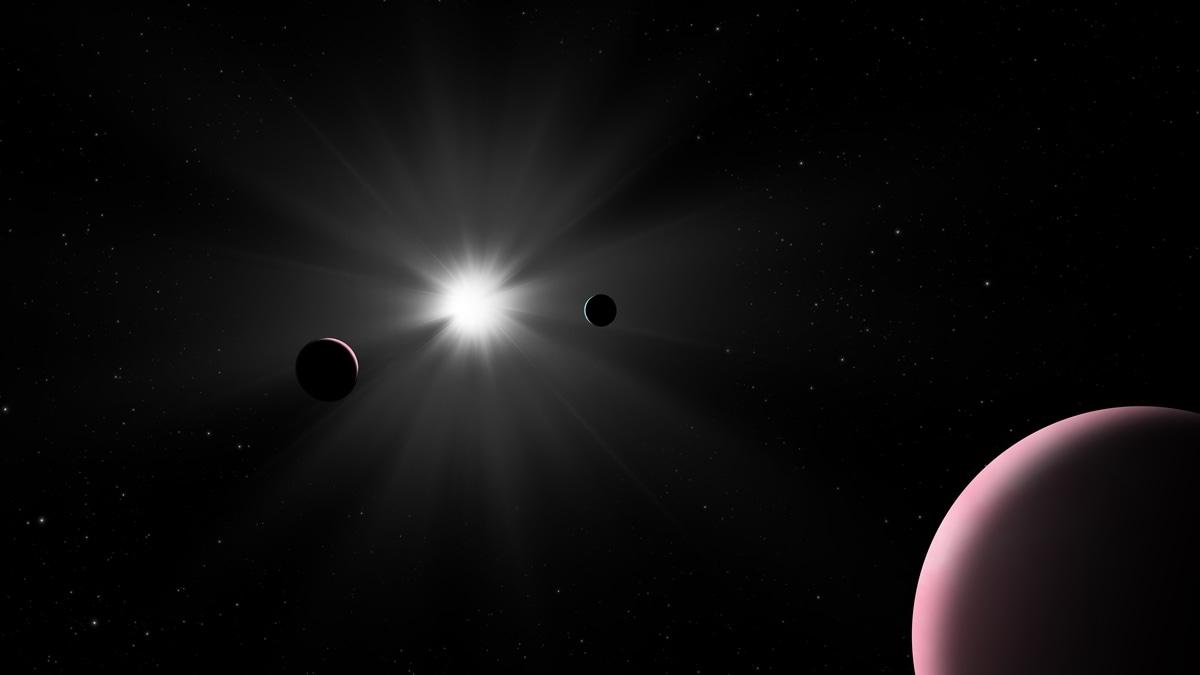
Many more planets may have large amounts of water than previously thought—as much as half water and half rock, new research suggests.
However, rather than flowing freely like the rivers on Earth, the water on these planets is likely to be embedded in the rock.
All life on Earth needs water to survive, so when scientists look for signs of life throughout the galaxy, planets with water are always at the top of their list.
Rafael Luque, first author on the new paper and a postdoctoral researcher at the University of Chicago, said: “It was a surprise to see evidence for so many water worlds orbiting the most common type of star in the galaxy.
“It has enormous consequences for the search for habitable planets.”
As stars are so much brighter than their planets, the actual planets themselves cannot be seen.
Instead, scientists detect faint signs of their effects on their stars – the shadow created when a planet crosses in front of its star, or the tiny tug on a star’s motion as a planet orbits.
That means many questions remain about what these planets actually look like.
Co-author Enric Palle of the Institute of Astrophysics of the Canary Islands and the University of La Laguna, said: “The two different ways to discover planets each give you different information.”
Scientists can gauge the diameter of the planet by analysing its shadow when it crosses in front of its star.
And they can assess its mass by measuring the tiny gravitational pull that a planet exerts on a star.
By combining the two measurements, scientists can get a sense of the makeup of the planet.
The researchers took a population-level look at a group of planets that are seen around a type of star called an M-dwarf – the most common stars seen in the galaxy.
The densities of a large percentage of the planets suggested that they were too light for their size to be made up of pure rock, the researchers say.
They suggest that instead these planets are probably something like half rock and half water, or another lighter molecule.
The findings are published in the Science journal.

The unexpected link between your diet and your anxiety
- 14 hours ago

Gold prices plunge in Pakistan, global markets
- 6 hours ago

Gunman in Brown University shooting found dead, linked to MIT killing
- 5 hours ago

ATC acquits SM Qureshi, awards 10-year sentences each to Dr Yasmeen, Ejaz Chaudhry in May 9 case
- 5 hours ago

Morocco beat Jordan 3-2 after extra time to clinch Arab Cup
- 5 hours ago

PM Shehbaz performs groundbreaking of Centre of Excellence for Autism
- 5 hours ago

Soccer legend Ronald debuts in Hollywood, to play key role in upcoming movie
- 5 hours ago
PMD to install Advanced Automatic Weather Stations
- 4 hours ago

The looming showdown over IVF, explained
- 14 hours ago

UN experts raise objections on India's unilateral actions of May 7 inside Pakistan
- 5 hours ago

The mass shooting on Australia’s Bondi Beach, briefly explained
- 14 hours ago

More than 42mn children administered polio vaccination during final polio drive in Pakistan
- 4 hours ago