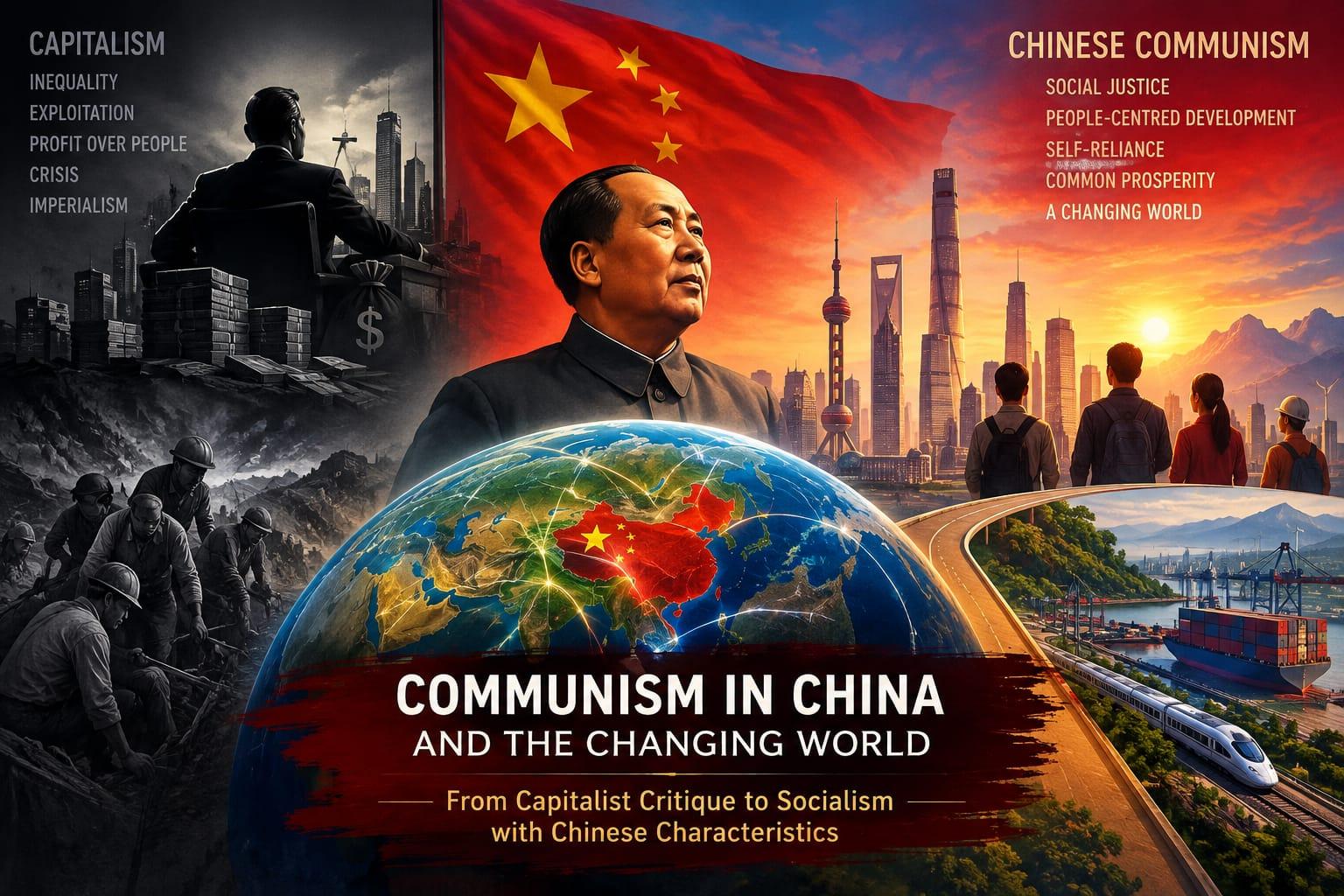
Communism in China and the changing world: from capitalist critique to socialism with Chinese characteristics
How Beijing has adapted socialist ideology to global economic realities

Kamran Khan
Capitalism has been a powerful economic and political system in modern times. Capitalism mainly relies on ownership, competition, profit, and market forces. Capitalism has helped with growth, new technology, and overall economic expansion.
Still, capitalism has also sparked discussions about inequality, exploitation, the concentration of wealth, and unequal chances to succeed. The difference between those who own capital and those who work for them has been a worry for political thinkers in the nineteenth century.
In this context, Karl Marx and Friedrich Engels wrote their critique of capitalism. Marx and Engels said that capitalist society is split mainly between those who own the means of production and those who sell their labour.
According to Marxist thought, capitalism can create wealth. Also produces class conflict and uneven distribution. Communism arose as a vision of society that is based on collective ownership, social equality, and the eventual removal of class divisions.
China offers an important example of how these ideas have grown beyond Europe. After the Chinese Revolution of 1949, the Communist Party of China set up a state. Chinese communism did not stay unchanged. It went through stages, and especially after reforms that began in 1978, it added market mechanisms while keeping Communist Party leadership. Therefore, the Chinese example raises a question: how can a communist or socialist system adapt to a world that is ruled by globalization, markets, technology, and international competition?
The main problem of this paper is the changing relationship between capitalism and communism in the world. Capitalism has sparked growth and new ideas. Concerns about inequality and the concentration of economic power are still strong. Traditional communist systems tried to solve these problems through ownership and state planning, yet they faced their own economic and institutional difficulties.
China is a special case because it did not simply leave communism when it started economic reforms. Instead, it built a model that mixes political ideas with market mechanisms. The problem therefore is to understand how Chinese communism has changed to fit national and global conditions and whether this change makes the Chinese model useful in the twenty-first century.
I think that this paper shows that the Chinese experience proves that communist ideology can adjust to changing global conditions by adding chosen market mechanisms while still keeping socialist principles and Communist Party leadership. China’s story suggests that staying true to ideology does not mean staying rigid in economics.
The core idea of communism comes from Karl Marx and Friedrich Engels. Marx’s study focused on class struggle and the link between capital and labour. He argued that capitalism creates a conflict between the bourgeoisie, who own the means of production, and the proletariat, who do not own the means of production.
Vladimir Lenin took Marx’s ideas further by stressing the need for a revolutionary party. Lenin’s view became very influential in shaping governments.
Mao Zedong changed Marxism and Leninism to fit China. China was mainly a society, not an industrial one like nineteenth-century Europe. Mao therefore made peasants and revolutionary action a central focus. After the People’s Republic of China was founded in 1949, the Communist Party pushed for change and tight economic planning.
Later, China showed that socialism cannot be a fixed formula. Starting in 1978, Deng Xiaoping started reforms and opening up. Market mechanisms, foreign investment, and more economic flexibility became parts of China’s growth plan. This move led to the idea of a " market economy" and the broader picture of "Socialism with Chinese Characteristics.”
This change matters because China did not simply pick capitalism or old-style central planning. Instead, it took an approach where the state keeps a big role while markets also work in the economy.
The important trait of modern Chinese communism is its ability to keep ideological continuity while also adapting in practice. The Communist Party is still the political body, while the economy includes state-owned companies and private businesses.
This strategy became especially important as China grew more connected to the global economy. Trade with countries, new technology, foreign money and worldwide competition pushed China to change its economic rules. At the time, Chinese leaders kept focusing on socialism, national growth, and long-term plans.
The Chinese case challenges the idea that communism must always work with a centralized economy. China shows that a Chinese socialist political system can use market mechanisms to
help grow while still keeping state involvement. If you watch how China moves, you see how ideas can shift.
In a changing world, China is putting focus on technological development, innovation, modernization, and national growth. China tries to meet challenges such as tech competition, economic change, environmental concerns, and shifts in the global order. If you follow China’s steps, you notice technology as a priority.
The Chinese model also has challenges. Economic inequality, differences, changes in the population, environmental pressures, and the need for ongoing tech innovation all call for effective policies. The Chinese experience should not be seen as a universal formula. China’s growth must be understood in relation to China’s history, institutions, people and national conditions. If you think about the challenges, you realize how complex growth can be.
The Chinese experience shows that political and economic systems can change with circumstances. China’s reforms show that the link between the state and the market does not have to be seen as a choice between capitalism and socialism. China has tried to use market forces for growth while keeping a role for the state and the Communist Party. If you compare China’s path, you notice a blend of old and new.
The main lesson is that an ideology can keep its core ideas while changing its rules. China’s approach has moved from communism to a more complex model of socialism with Chinese characteristics. If you look closely, you see how core ideas stay, but rules shift.
Countries looking at the experience should not try to copy China’s system exactly because each country has a different history, society, and politics. Instead, they can study parts of China’s development. If you study China, you learn why copying does not work.
First, governments should concentrate on long-term economic plans instead of only short-term politics. If you plan for the future, you see why long-term matters.
Second, investing in education, science, technology, and people’s growth must be seen as essential for progress. If you invest in people, you see growth.
Third, market tools can be used when they boost productivity and innovation. Governments must also watch inequality and social welfare. If you balance markets, you avoid gaps.
Fourth, strong institutions are needed to carry out development plans. Economic changes without institutions may cause instability instead of lasting growth. If you build institutions, you ensure stability.
Finally, developing countries should learn from China’s ability to adjust its policies to conditions while building their own models for their own country. If you adapt like China, you can grow.
The debate between capitalism and communism stays important because both systems came from answers to economic organization and social inequality. Capitalism has produced economic innovation and growth, but its uneven wealth distribution stays a major criticism.
Communism emerged partly as a reply to those problems. Gave an alternative based on shared ownership and social equality. If you weigh both, you see the trade-offs.
China gives an example because it has not stayed fully in the old central planning model nor simply turned into a normal capitalist system. Instead, China has built a system called socialism with characteristics, mixing Communist Party leadership, a socialist market economy, and wide involvement, in the world economy. If you look at China, you see a blend.
The Chinese experience shows that an ideology’s survival and growth may rely on its ability to react to realities. In a changing world, China’s experience gives an important example of how communism has changed from a revolutionary idea into a modern system of government and economic growth. If you consider China, you learn flexibility.
-- The writer is a student of the Department of Political Science and Pakistan Studies at the University of Malakand

Bollywood actor Tiger Shroff shot at in Mumbai, three suspects held: police
- 34 minutes ago

Character.AI files for bankruptcy
- 3 days ago

Buying Apple’s wall-mounted HomeView? The mount costs extra
- 2 days ago

Here are all the new HomePod Mini 2 colors
- 3 days ago

Hands-on with the Apple Home Collection
- 2 days ago

West Bank settlers brutally attack a Washington Post journalist
- a day ago

FIA offloads 2 passengers at Lahore airport over fake documents, tampered study visa
- a day ago

Florida’s uniquely horrifying death penalty system
- 2 days ago

Will November stop Trump’s agenda?
- 2 days ago

Security of Haramain al-Sharifain non-negotiable: DG ISPR
- 2 hours ago

Cold weather and high prices could flip the Senate
- 2 days ago

Trump’s revenge campaign comes for Ilhan Omar
- 2 days ago